 Website audit
 SEO audit
 Technical audit
 UX & Conversion audit
 AI/LLM Visibility audit
 Ecommerce audit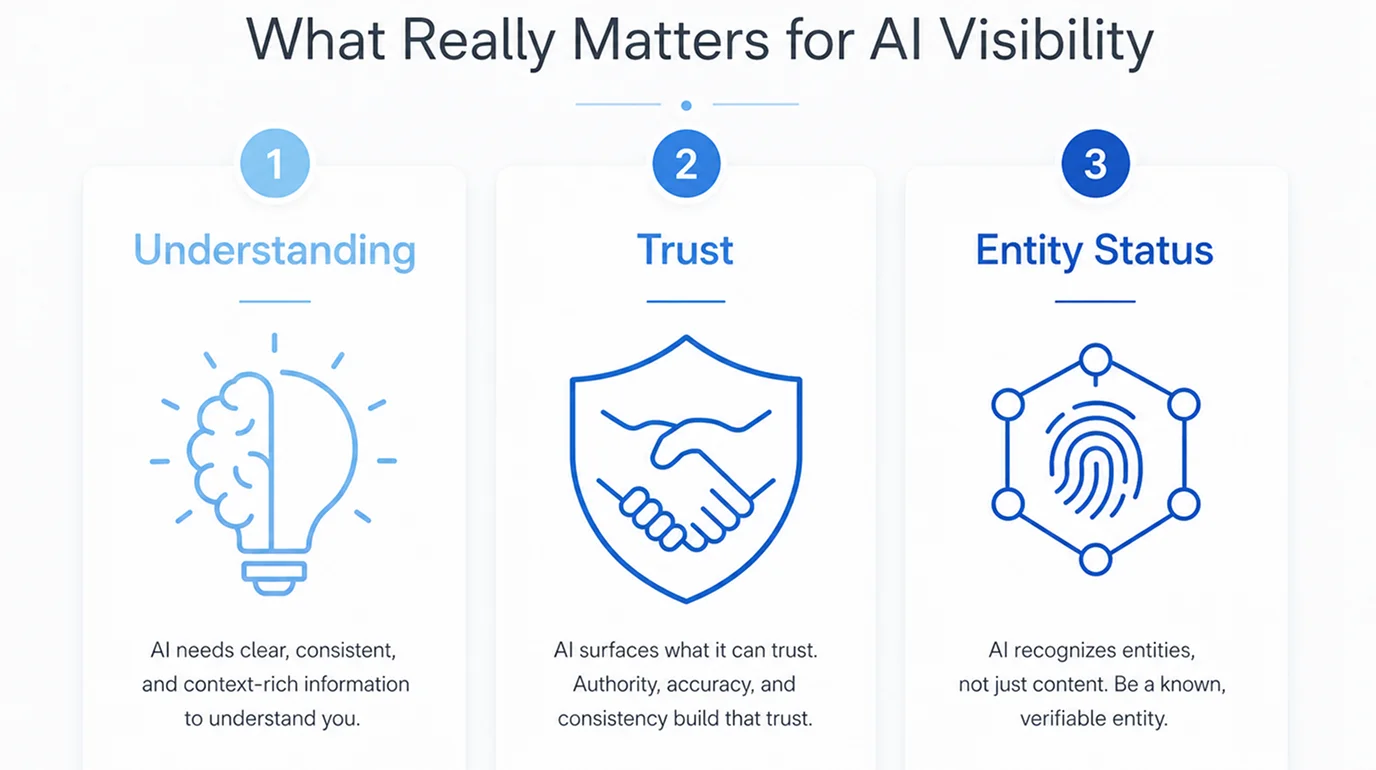
A lot of sites look polished and well-optimised - but for different reasons, they stay invisible in AI. You can invest everything into design, but without a clear entity signal, AI simply skips you. Or you can have a strong outreach team and solid backlinks, but if the site itself is hard to parse, the problem comes back anyway. These three things kept showing up as the real drivers across every audit - and that's what I want to talk about here.
1. Understanding
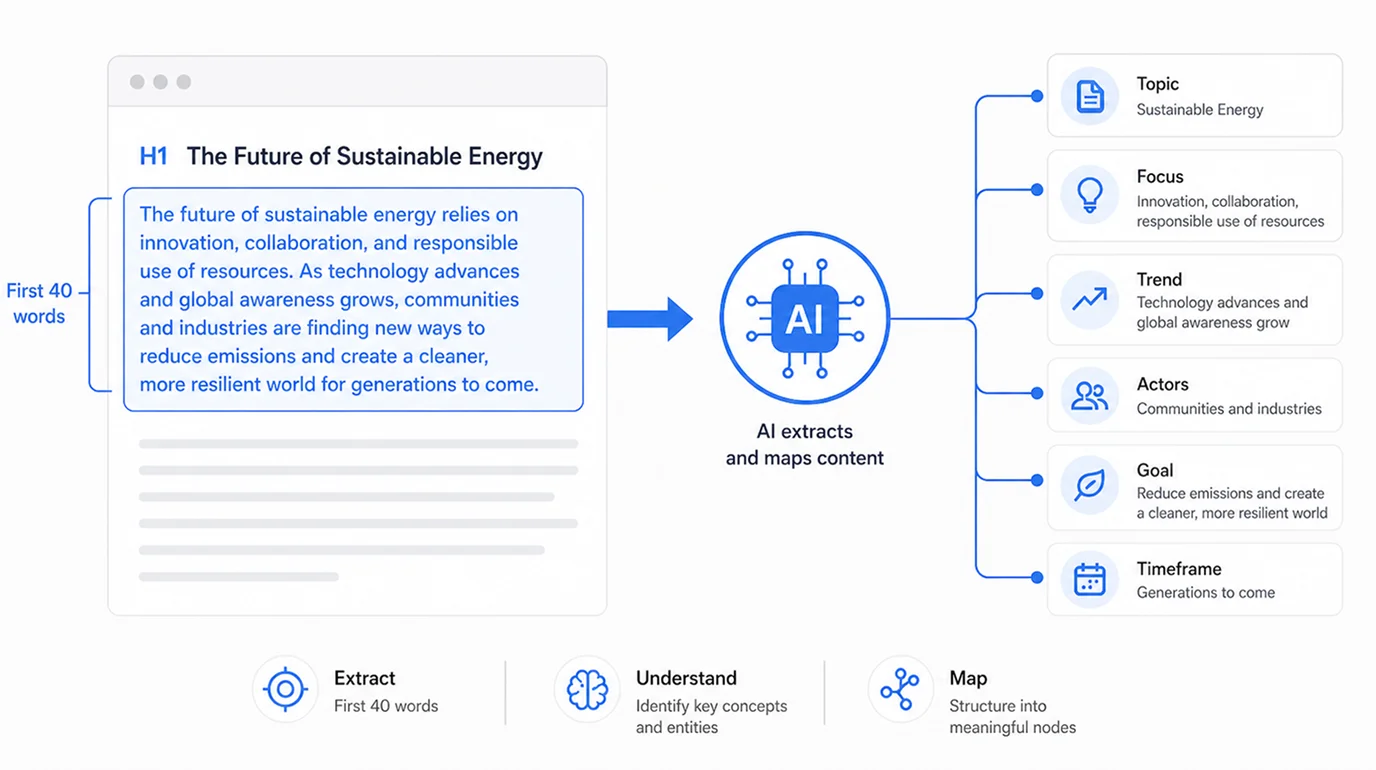
How clearly can AI understand your site? Here are the most crucial things to check: does your site have a clear content structure? Is all text visible in the source code, not rendered after page load? And most importantly - does your text answer the H1 or H2 header right within the first 40-60 words? If the content is easy to extract, summarize, and map - you're already ahead of most. That's the foundation everything else builds on.
This is where a lot of sites fall apart. They try to say too much on one page, hide the important point under layers of fluff, or structure content in a way that feels intuitive to read but is hard for AI to extract and map cleanly. If the page is vague or overloaded, AI has to work harder to find the real meaning - and that already works against you.
The real problem in most audits came down to one thing: clarity. The sites that performed better were usually the ones that made the topic obvious very fast - ideally within the first 40 words of a section. AI has limits on how much it processes and weighs. If the main point is buried under filler, the content gets treated as low quality - and low quality content gets ignored by AI.
2. Trust
AI trust works through pattern recognition across the web: who mentions you, in what context, and how consistently that story repeats. Sites with strong external reinforcement get cited. Sites with isolated claims - even good ones - get ignored. That's the core mechanic.
This is why Google has been preparing us for this for years. First, links were mostly about quantity. Then the search world moved toward quality, relevance, and topical fit. Having "a link" stopped being enough - it mattered where it came from, what kind of site it was, and whether that source was actually related to your topic.
AI visibility is the next step of that same evolution. The question shifted from "do you have links?" to "who mentions you, in what context, and does that context support the identity you want to build?" A brand with the right mentions and citations can feel far more visible to AI than a brand with a larger but weaker backlink profile.
Trust is the one I've seen override the others most often. A site with serious technical issues can still show up in AI answers if the external mention pattern is strong enough. But this applies to established sites with genuine authority behind them. For newer sites - a year old, even with around 1,000 quality links - the logic works differently. AI applies a different standard to brands still building a track record. The signals need time to compound. See how your site's trust signals hold up - AI & LLM visibility audit.
3. Entity Status
AI thinks in terms of entities: who you are, what you do, what topics you belong to, and what you are consistently connected with across the web. Pages rank. Entities get recognized.
In practice, a site can be technically solid and still feel invisible if the brand has no clear footprint. Strong trust signals help - but trust is about whether AI believes you. Entity is about whether AI knows who you are. A brand can have hundreds of quality links from different niches and still have a weak entity, because the topical association is scattered. AI understands that people trust you, but lacks a clear picture of what you actually stand for.
This is also where a personal name matters. When a real person is consistently connected to a brand - mentioned by name in articles, interviews, or citations within the same topic - AI builds a stronger identity map. The name reinforces the brand, the brand reinforces the topic, and the connection grows over time.
The best audits confirmed this pattern. The site was decent. The entity was weak. And that is a very different problem.
Why This Matters Now
The backlink conversation has changed. First it was quantity of links, then quality and topical relevance, now AI asks whether the internet collectively reinforces who you are. Link building focused on topical context and brand identity wins. Everything else is optimising for a game that already ended.
- Sites with a real author consistently publishing in one topic grow traffic as the body of work grows
- Topical backlinks outperform high-volume scattered links in AI visibility
- A person behind the brand accelerates entity recognition and compounds over time
What I Keep Seeing in Audits
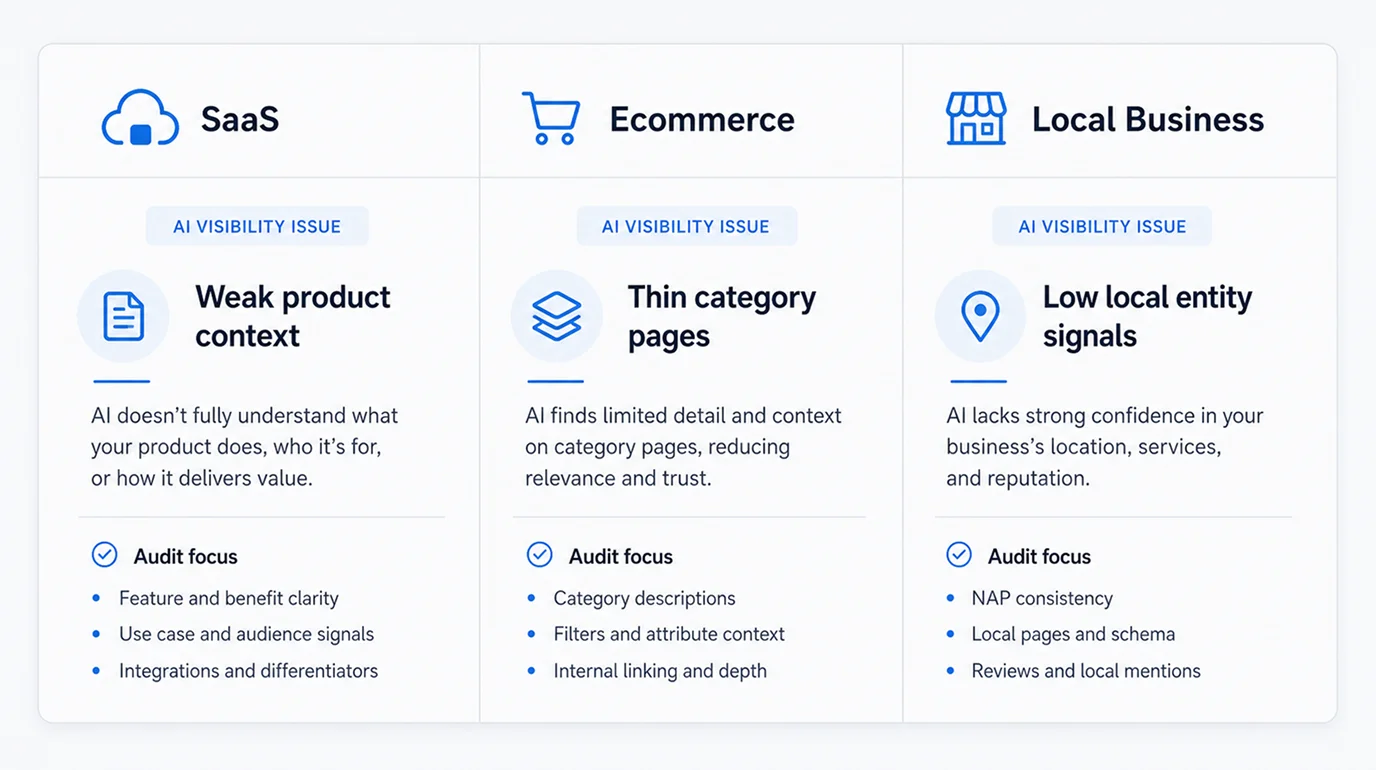
The patterns across audits vary by site type, but they are consistent within each category.
SaaS projects most often struggle with technical structure: broken heading hierarchy and JavaScript-rendered text that AI simply cannot see. The content exists, but AI has no access to it.
Ecommerce sites have a content gap. Most product pages say too little - thin content that skips the actual answer gets ignored by AI regardless of how good the site looks. Usability issues are common too, but those have little impact on AI visibility.
Local business sites often invest heavily in local SEO - maps, citations, local directories - while the main site and backlink profile stay weak. That works for local search, but in AI visibility it is a serious disadvantage. AI pulls from the broader web, and a thin site with few authoritative links simply falls behind.
Across all site types, the most common gap was the same: backlinks from genuinely trusted, topically relevant sources. Most sites had links. Far fewer had the right links - ones that reinforce both trust and entity within a specific niche. More on why that gap exists - Why your competitors are visible in AI
What to Do with This
Understanding, trust, and entity status compound each other. A clearer site gets cited more. More citations build entity. Stronger entity attracts better links. The brands winning in AI visibility are the ones where all three work as one system.
A real example from a recent audit: while developing the WebAudits tool, I ran a test audit on ClickUp and found three H1 tags on the homepage - a basic structural mistake. It ranks well and gets cited by AI consistently. Trust and entity signals are so strong that they override technical imperfections at that level. That is the clearest proof I have seen: optimisation matters, and trust and entity take it further.
One place to start: pick one real author, one core topic, and publish consistently. That single move touches all three layers at once.
Frequently Asked Questions
Why does entity status matter more than page optimization?
AI processes the web through entities. A site needs a real topical footprint - consistent mentions, a recognized author, and clear subject association - for AI to identify and trust it. On-page optimization alone leaves that identity gap unfilled.
Can a site with technical errors still appear in AI answers?
Yes. ClickUp has three H1 tags on the homepage and still gets cited by AI consistently. Strong entity and trust signals carry more weight than structural perfection.
What type of backlinks actually help AI visibility?
Topical backlinks from trusted sources within your niche drive entity recognition. High-volume links from scattered, unrelated sites build domain authority while leaving AI trust patterns untouched.
Where should the main answer appear on a page?
Within the first 40-60 words after the H1 or H2 header. AI extracts and weighs content from the top of each section - the main point belongs at the front.
What is the fastest way to start building AI visibility?
Pick one real author, one core topic, publish consistently. That combination builds understanding, trust, and entity recognition at the same time.