 Website audit
 SEO audit
 Technical audit
 UX & Conversion audit
 AI/LLM Visibility audit
 Ecommerce audit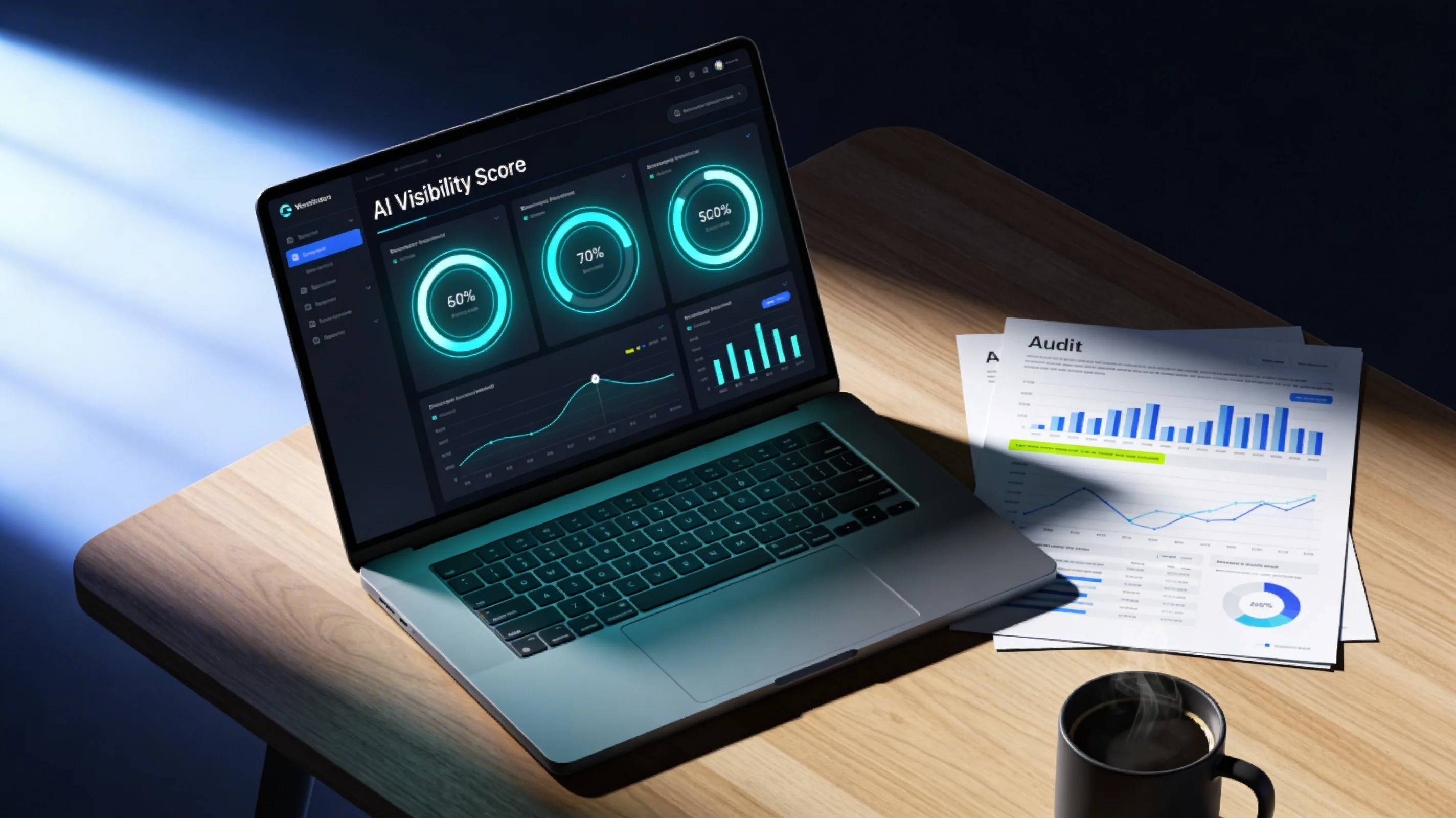
Most of the sites we audited looked fine on the surface. Good design, decent traffic, years of SEO work behind them. But when we checked how they appeared in ChatGPT, Perplexity, and Gemini - they were basically invisible. That's the gap we keep running into. And after 20 audits - different industries, different sizes, different budgets - the same mistakes show up almost every time.
What "AI Visibility" Means
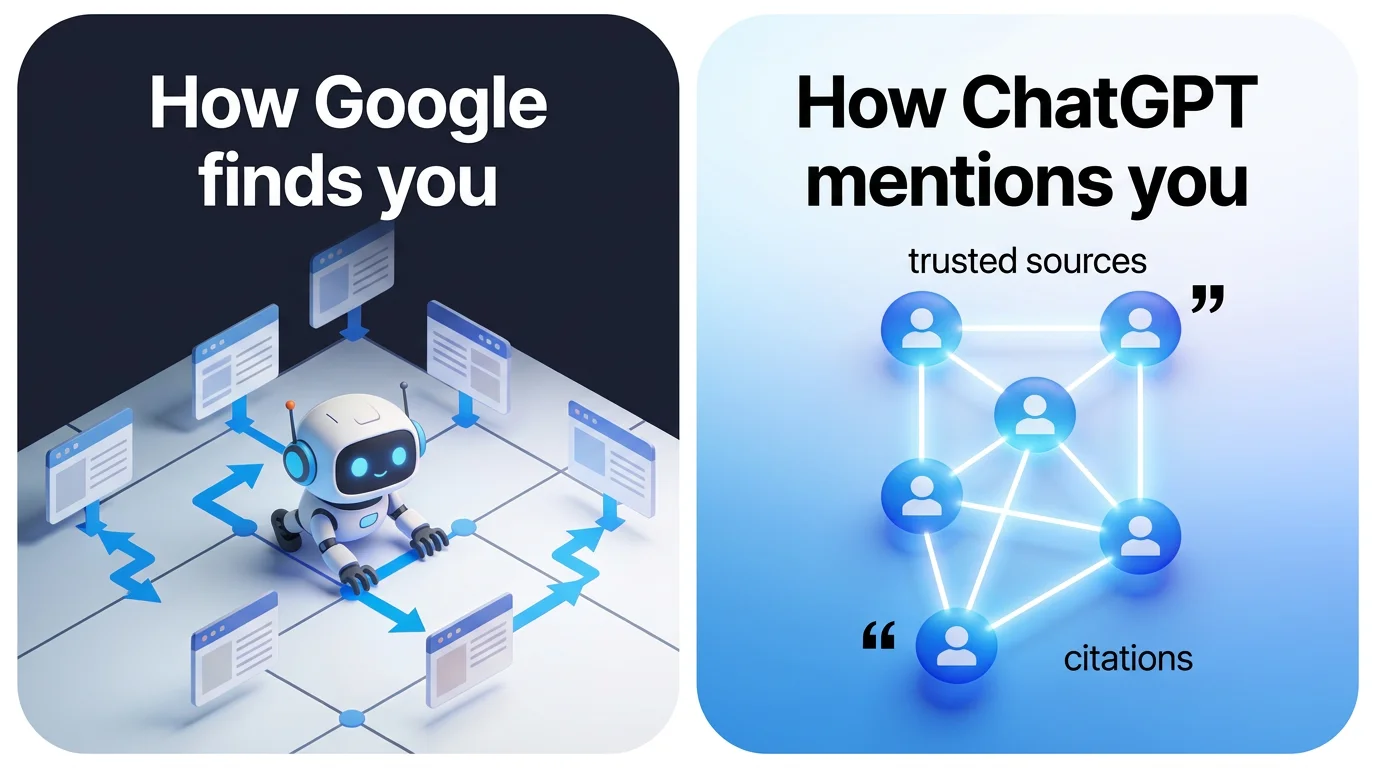
When someone types a question into ChatGPT or Perplexity, those tools don't run a Google search. They pull from a model trained on billions of web pages - and they prioritize sources they can verify, understand, and trust. Being "visible" to AI means being the source it reaches for when your topic comes up.
| Traditional SEO | AI Visibility | |
|---|---|---|
| Goal | Rank on page 1 | Get cited or referenced by AI |
| Signal | Backlinks + keywords | Authority, structure, trust signals |
| Format | Keyword-optimized content | Direct answers, Q&A, schema |
| Who crawls you | Googlebot | AI crawlers + LLM training data |
| Timeline | Weeks to months | Months to over a year |
How We Run These Audits
For each site, we look at four layers: technical health, content structure, trust signals, and what we call the "AI footprint" - how and where the site is mentioned across the web by sources that AI models learn from. We run each site through a combination of tools, manual checks, and direct AI queries. Yes, we literally ask ChatGPT, Claude, and Perplexity about the brand and see what comes back.
The results are often eye-opening. A site can have 10,000 monthly visitors from Google and return zero mentions in any AI tool.
→ Want to see what an actual audit report looks like? Check out a sample report here.
The 7 Mistakes We Found
1. No Structured Data - So AI Has No Idea Who You Are
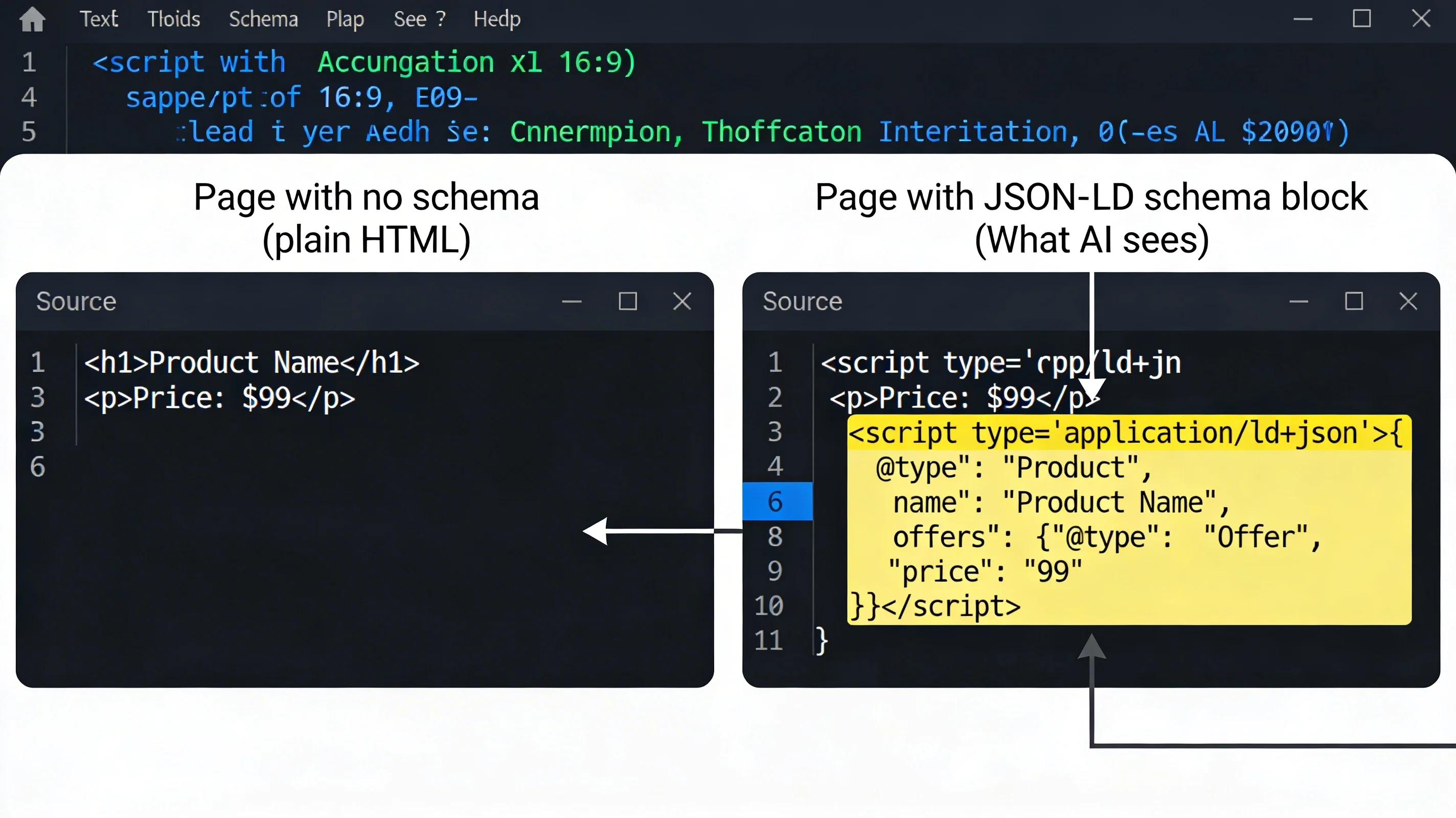
Schema.org markup is how you formally tell machines what your business does, who you are, and what your content covers. Out of 20 sites we audited, only 3 had meaningful JSON-LD structured data implemented correctly. Without it, AI models are guessing your context from raw text. Sometimes they guess right. Usually they don't mention you at all.
What to do: At minimum, implement Organization, WebSite, and WebPage schema on every page. For service businesses, add Service and LocalBusiness where relevant. If you publish content, use Article with author markup.
2. Content Written for Keywords, Not Questions
Almost every site we reviewed had content optimized for short-tail keywords - "web design agency," "SEO services," etc. - but almost none of it answered questions directly. AI doesn't rank pages. It extracts answers. If your content doesn't contain a clear, direct answer to a real question, it won't get pulled.
| Old SEO-style copy | AI-friendly rewrite |
|---|---|
| "We offer top-tier web design services" | "What does a web design audit include? Here's what we check..." |
| "Our SEO experts drive results" | "Why isn't my site showing up in AI search? Three common reasons:" |
| "Industry-leading technical audits" | "How long does a technical SEO audit take? For most sites, 5-7 business days." |
What to do: Audit your existing pages and identify 2-3 questions each page could directly answer. Rewrite at least the opening section to lead with the answer, not the pitch.
3. No Clear "Who Are You?" Signals - And AI Won't Guess
Google spent years rewarding anonymous content. AI tools don't work that way. We found that 16 out of 20 sites had zero author attribution - no bylines, no bios, no named humans anywhere. From an AI model's perspective, that content exists in a trust vacuum. It might get indexed. It almost certainly won't get cited.
| Signal | What it looks like | Why it matters to AI |
|---|---|---|
| Named author | Full name on every article or page | AI cross-references names across the web to verify real people |
| Author bio | 3-5 sentence bio with specific experience | "10 years in SEO" means nothing - "ran audits for 200+ SaaS companies" is verifiable context |
| External author presence | LinkedIn profile, Twitter/X, other publications | AI connects the same name in multiple credible places as a trust signal |
| Credentials or proof | Specific past work, client results, certifications | Vague expertise claims are filtered out - specific, verifiable ones are weighted higher |
| Founder visibility | CEO/founder named and linked on the About page | Brands with named, visible founders are treated as more legitimate entities |
Sites where the founder had even a modest public presence - a LinkedIn profile with real activity, a couple of bylined articles, a mention in industry content - consistently performed better in AI visibility than sites where the business felt faceless.
One site we audited had excellent content - genuinely good writing, real insights. But there was no author name anywhere. When we queried the brand in three AI tools, nothing came back. When we added a proper author page, linked it to an active LinkedIn profile, and published one external bylined piece under the same name, the picture started changing within 8 weeks.
The E-E-A-T connection - and why it hits harder in AI search
AI models are specifically trained to prioritize citable, trustworthy sources and filter out content that can't be attributed or verified. Anonymous content isn't penalized - it's just deprioritized by default.
- Experience - describe specific situations, real numbers, actual client scenarios
- Expertise - your author page shows a career path that leads logically to this topic
- Authoritativeness - other credible sources have mentioned or linked to you in this topic area
- Trustworthiness - privacy policy, clear contact info, real business signals, no misleading claims
What to do - in order of priority:
- Add a real author page - name, photo, 4-6 sentence bio with specific experience, link to LinkedIn
- Put your name on everything - every Resources post, every service page with editorial content, every case study
- Make your About page a trust document, not a marketing page
- Link your author profiles to LinkedIn - make sure it looks active and complete
- Get your name published somewhere outside your own domain - one guest article, one podcast mention, one industry interview
4. No FAQ Sections - Anywhere
FAQ format is essentially how large language models are structured: question → answer. Only 4 of the 20 sites had any FAQ sections at all. And of those four, two had FAQ schema markup missing - so even the content that existed wasn't being read correctly by AI crawlers.
What to do: Add a 4-6 question FAQ block to every service page. Use FAQPage schema. Write answers in 2-4 sentences, direct and specific. These become direct citation candidates.
5. Slow Pages, Poor Mobile - Still a Problem in 2026
We expected this to be mostly solved by now. It's not. AI crawlers factor in page experience signals - and slow, broken pages are less likely to be included in training data refreshes. The average LCP across the sites we audited was 4.1 seconds. The target is under 2.5s. More than half the sites failed basic Core Web Vitals on mobile.
What to do: Run your site through PageSpeed Insights. If your LCP is above 3s on mobile, fix that first - before any content work.
6. No Topical Authority - Scattered Content
One post about SEO. One about social media. One about web design. Two about company news. That's not a content strategy - and AI knows the difference. AI models build a "knowledge map" of what each domain is authoritative about. We saw this scattered pattern in roughly 70% of the sites we reviewed.
What to do: Pick 2-3 core topics that directly relate to your services. Build at least 4-5 pieces of content per topic, internally linked. This is called a topical cluster - and it signals domain authority to both Google and AI tools.
7. No External Mentions - The Mistake Most People Miss Completely
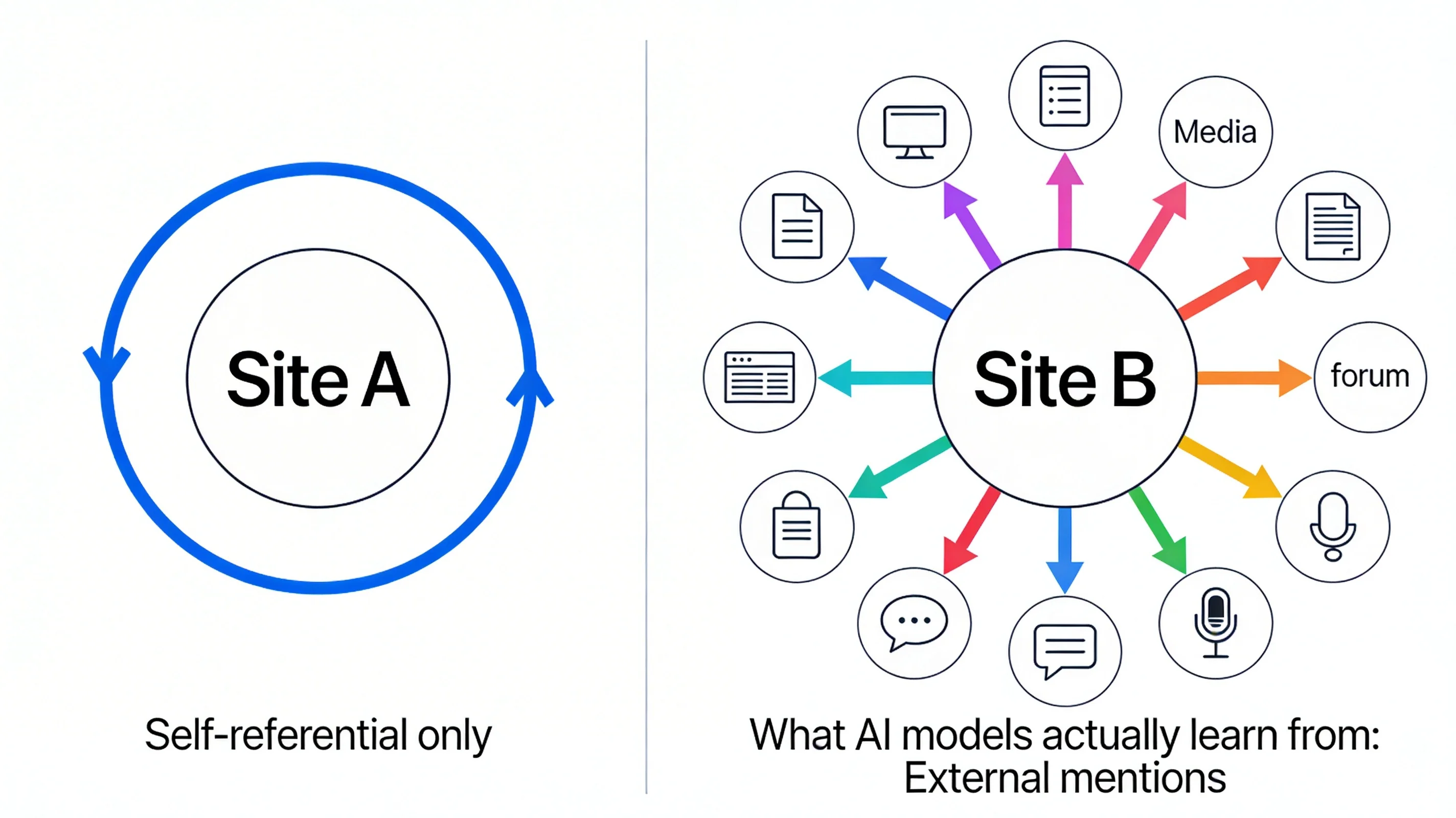
17 of the 20 sites had almost nothing outside their own domain. Some had solid backlink profiles - but backlinks for Google and mentions for AI are not the same thing, and confusing the two is one of the most expensive mistakes we see.
| SEO Backlink | AI Citation Signal | |
|---|---|---|
| What it is | A link from another site to yours | A mention, reference, or discussion of your brand anywhere on the web |
| What matters | Domain authority, anchor text, dofollow | Context, credibility of the source, topical relevance |
| Nofollow links | Low SEO value | Can carry significant AI weight - AI reads the text, not just the link attribute |
| Where it lives | Direct link on a page | Articles, directories, Reddit threads, podcasts, reviews, Q&A sites |
| Who processes it | Googlebot | LLM training data crawlers, RAG retrieval systems |
A nofollow mention of your brand in a relevant Reddit thread can do more for your AI visibility than a dofollow link from a low-relevance Resources. We tested this across multiple audits. It holds.
- Authoritative directories - Crunchbase, Clutch, G2, Capterra, Product Hunt. Consistently included in LLM training datasets.
- Reddit and niche forums - AI models heavily index Reddit. A legitimate discussion thread where your brand is mentioned registers as a trust signal.
- Guest articles on real publications - Actual bylined articles in industry publications your audience reads.
- Podcast appearances - Podcast transcripts are indexed. Even mid-size podcasts in your niche count.
- PR and press mentions - One article in a credible regional or industry publication can establish your brand faster than six months of on-site content.
- Wikipedia-adjacent sources - Wikidata, industry wikis, knowledge bases. Disproportionately strong signal for AI models.
What to do - in order of impact:
- Claim and complete your Crunchbase and Clutch profiles - fast wins, high-authority, directly indexed by AI pipelines
- Get 3-5 genuine client reviews on G2 or Clutch
- Find 2-3 industry publications that accept contributor pieces
- Search Reddit for threads in your niche and contribute honestly
- Book one podcast appearance - even a small show. The transcript is what matters.
- Set up Google Alerts for your brand name
What a Healthy AI-Visible Site Looks Like
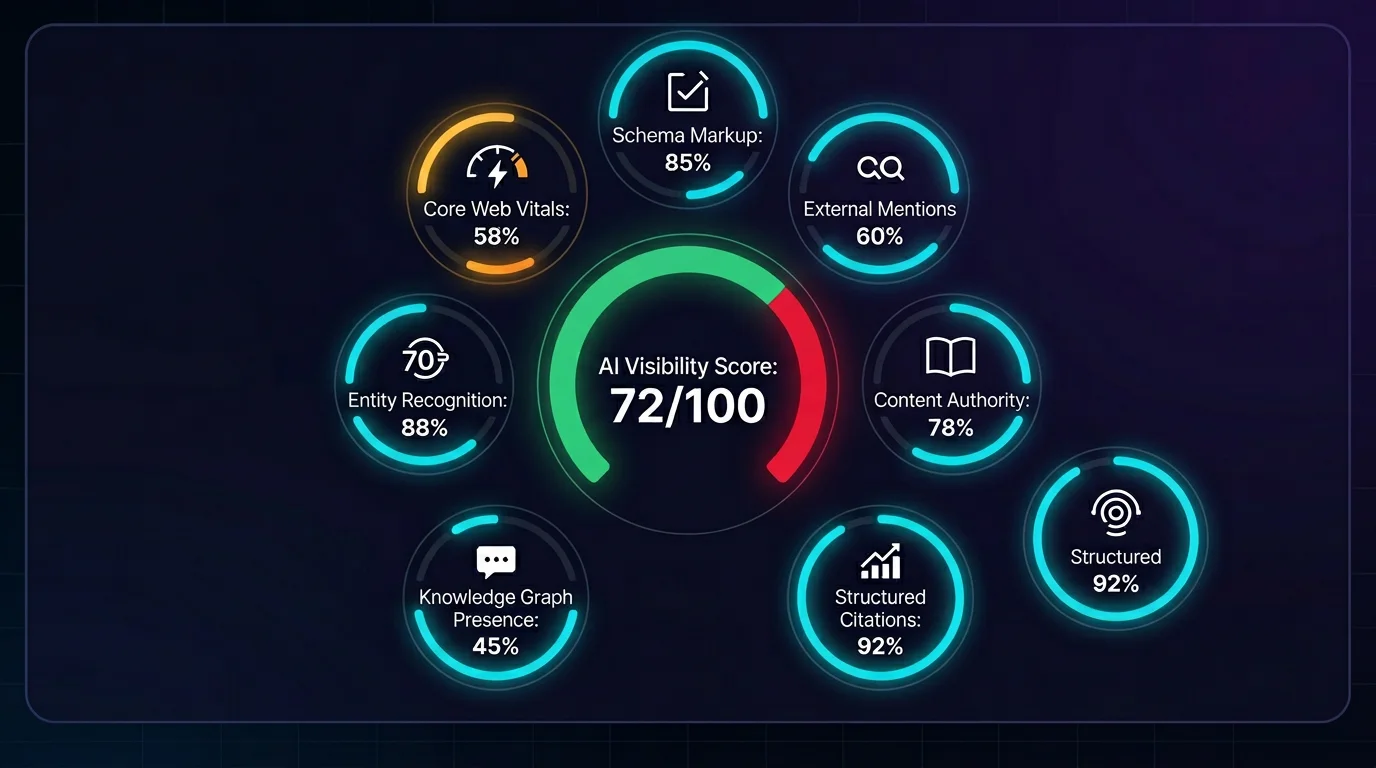
By audit #8, we stopped being surprised. The sites showing up in AI tools weren't perfect - but they consistently hit most of these:
| Signal | Healthy benchmark |
|---|---|
| Schema markup | Organization + FAQPage + Article on all key pages |
| Content format | Answers questions directly in first 100 words |
| Author trust | Named author, bio, linked external profiles |
| External mentions | 10+ citations from credible third-party domains |
| Core Web Vitals | LCP < 2.5s, passes mobile CWV |
| Topical depth | 4+ posts per core topic, internally linked |
| FAQ sections | Present on every service/product page |
Before You Leave - Run This Checklist on Your Site
- JSON-LD schema implemented on all key pages
- Every service page answers at least one direct question in the first paragraph
- Named author with bio and credentials on all content
- FAQ section with schema markup on service and product pages
- Core Web Vitals passing on mobile
- 4+ content pieces per core topic, internally linked
- 10+ mentions of your brand on credible external sites
If you checked fewer than 4 of these, your site has real AI visibility gaps - and they're likely costing you traffic you don't even know you're missing.
Want to See a Real Audit Report?
We put together a sample AI Visibility Audit report based on a composite of what we typically find. It shows the exact areas we evaluate, how we score them, and what recommendations look like in practice.
See the sample audit report here - no form, no email required. Ready to see where your site stands? Book an AI Visibility Audit.
Frequently Asked Questions
What's the difference between SEO visibility and AI visibility?
SEO visibility means your site ranks in Google search results. AI visibility means AI tools like ChatGPT, Perplexity, Claude or Gemini reference or cite your brand when someone asks a relevant question. A site can have strong Google rankings and zero AI presence - we see this in almost every audit we run.
How do I check if my site is visible in AI search right now?
Open ChatGPT, Perplexity, and Google's AI Overview separately. Search for your main service + location or niche - for example, "best web design agencies for SaaS companies." Then search your brand name directly. If you don't appear across all three tools, your AI footprint needs work.
How long does it take to improve AI visibility?
Much longer than SEO. On-page fixes like schema and FAQ sections can show impact in 4-8 weeks. Building external mentions - directories, press, guest content - takes 3-6 months before AI models consistently pick them up. The sites we've seen move fastest attack both simultaneously, not sequentially.
Does AI visibility affect my Google rankings too?
Not directly. But most of the signals that improve AI visibility - E-E-A-T, structured data, topical authority, external mentions - are the same signals Google has been weighting more heavily since 2023. Fixing your AI visibility gaps almost always improves your Google performance as a byproduct.
Do I need a separate strategy for each AI tool - ChatGPT, Perplexity, Gemini?
The core signals are shared: credible content, verified authorship, structured data, external mentions. Where they differ is retrieval. Perplexity actively crawls the web in real time, so fresh content picks up faster there. ChatGPT and Gemini rely more heavily on training data, which updates on longer cycles.
Is an AI visibility audit worth it if my business is local or small?
Especially then. Local and small businesses are dramatically underrepresented in AI search right now - which means competition for AI citations in local niches is still low. A business that builds its AI footprint today will have a structural advantage that compounds over the next 2-3 years as AI search traffic continues growing.
What does an AI visibility audit include?
Ours covers seven areas: structured data, content format and question-targeting, author and E-E-A-T signals, external mention footprint, Core Web Vitals, topical authority and internal linking, and direct AI query testing across ChatGPT, Perplexity, and Gemini. You get a scored report plus a prioritized action plan. See a sample report here →