Ecommerce SEO Audit
Sample Report
Prepared for: [Ecommerce Store - Retail / Shopify]
Audit Overview
This SEO audit was conducted for an Ecommerce store running on Shopify. The store sells physical products across multiple categories and targets customers in multiple languages. The audit covers all layers that affect organic search performance: technical setup, on-page structure, mobile experience, structured data, local presence, backlink profile, and conversion-related UX signals.
All findings are based on a manual review combined with data from Google Search Console, Google PageSpeed Insights, Screaming Frog, SEMrush, and W3C validators. URLs and brand names have been removed from this sample report.
Project Objectives
- Technical SEO Audit
- On-Page Optimization Review
- Mobile Performance Assessment
- Structured Data & Schema Markup
- Local SEO Review
- Off-Page Profile Analysis
- Ecommerce UX Signals
Check crawlability, indexation, redirect chains, duplicate content, broken links, and code validation errors.
Analyze title tags, meta descriptions, heading structure, internal linking, and page relevance signals across key page types.
Measure Core Web Vitals on mobile and desktop. Identify render-blocking resources, image issues, and UX problems on small screens.
Check for missing or broken Schema on product pages, category pages, and the homepage. Map out what's needed for rich results.
Verify NAP consistency, Google Business Profile completeness, and local ranking signals.
Review backlink quality, Authority Score, and how the site compares to direct competitors in the same niche.
Check conversion-related signals on product pages: delivery time visibility, trust badges, return policy placement, cross-sell structure.
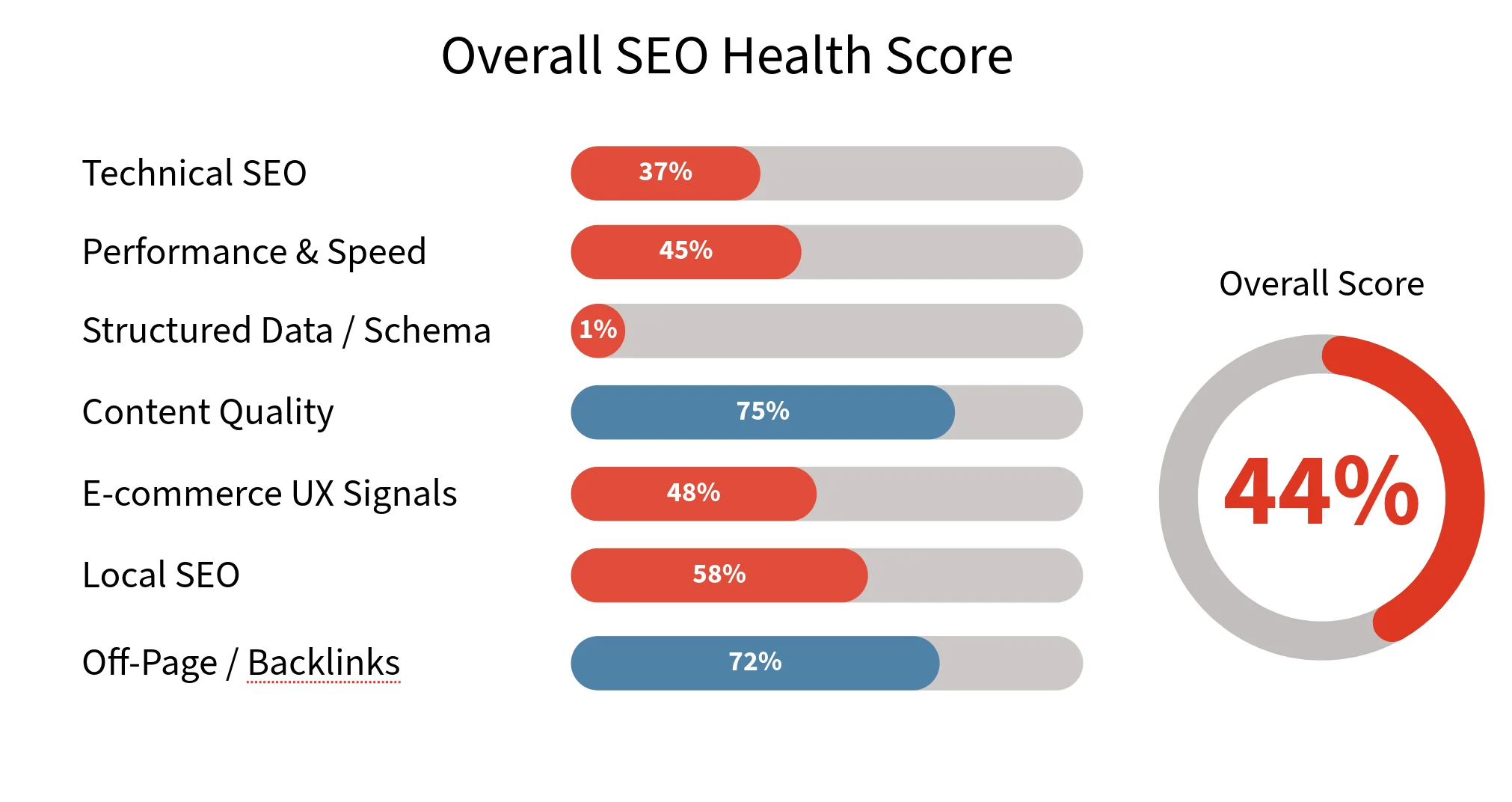
📊 SEO Health Score
Overall SEO Health: 44/100 - Multiple critical issues across technical, on-page, and mobile layers. The site has a solid content base and a competitive backlink profile, but both are currently undermined by structural and performance problems that limit how Google can crawl and rank the store.
🚨 Top 10 Critical Issues
| # | Issue | Impact | Priority |
|---|---|---|---|
| 1 | Mobile PageSpeed score: 12/100 | Google uses mobile-first indexing - this score directly pulls down rankings | ⚠️ CRITICAL |
| 2 | Schema markup completely absent | No rich results, no product ratings in SERP, no structured data for Google Shopping | ⚠️ CRITICAL |
| 3 | Duplicate titles and H1 tags across 40+ pages | Dilutes relevance signals; Google may not know which page to rank for a given query | ⚠️ CRITICAL |
| 4 | No canonical tags on product variant URLs | Each color/size variant gets indexed as a separate page, splitting ranking signals | ⚠️ CRITICAL |
| 5 | 2 broken pages (404) still linked internally | Wastes crawl budget; creates dead ends for users and bots | ⚠️ HIGH |
| 6 | Missing meta descriptions on most pages | Google generates its own snippets - typically worse CTR than a written description | ⚠️ HIGH |
| 7 | Duplicate text pages and collection pages targeting the same keyword | Neither page is strong enough to rank on its own - they compete against each other | ⚠️ HIGH |
| 8 | Product images have no ALT tags | Zero visibility in Google Image Search; accessibility violation | ⚠️ HIGH |
| 9 | Hreflang broken across multilingual pages | Wrong language version may be served to users; rankings split between locales | 🟡 MEDIUM |
| 10 | No www → non-www redirect configured | Both domain versions are accessible - Google may index duplicate content and split ranking signals between www and non-www | 🟡 MEDIUM |
📈 Expected Impact Timeline
Quick Wins (Weeks 1-2)
- Set up a 301 redirect from non-www to www (or vice versa). Confirm preferred domain version in Google Search Console.
- Restore or redirect the 2 broken 404 pages.
- Add canonical tags to all variant and parameter URLs.
- Write meta descriptions for top 20 highest-traffic pages.
- Fix duplicate H1 and title tags via template update.
- Add ALT tags to product images using a naming template.
Expected improvement: crawl efficiency restored, CTR improvement within 3-4 weeks as Google re-indexes updated pages.
SEO Foundation (Weeks 3-6)
- Implement Product Schema on all product pages.
- Add BreadcrumbList Schema to category and product pages.
- Merge duplicate text/collection page pairs with 301 redirects.
- Fix hreflang across all language variants.
- Convert all product images to WebP format.
- Fix Google Maps API on contact page.
- Resolve HTML and CSS validation errors (35 CSS errors found).
Expected improvement: rich results begin appearing in SERP within 4-6 weeks of schema deployment; page load time improvement visible in Search Console Core Web Vitals report.
Performance & Growth (Weeks 7-16)
- Target mobile PageSpeed score of 60+ through script deferral and image optimization.
- Build out Google Business Profile - photos, services, review requests.
- Add delivery estimates and return policy to product page templates.
- Improve internal cross-linking between related products.
- Clean up sitemap.xml and resubmit to Google Search Console.
- Monitor Core Web Vitals weekly via Search Console.
Expected improvement: organic traffic growth of 25-40% within 3 months of full technical cleanup; conversion rate improvement from UX fixes.
SECTION 1: TECHNICAL SEO

1.1 www / non-www Redirect - Not Configured
Status: 🟡 Issue Found
Priority: MEDIUM
Both www and non-www versions of the domain are accessible without a redirect between them. Google treats these as two separate URLs - meaning the same pages can be indexed twice, splitting ranking signals and link equity across duplicate versions of the site.
Fix: Set up a 301 redirect from the non-preferred version to the preferred one (e.g. non-www → www). Confirm the preferred domain in Google Search Console under Settings → Preferred domain.
1.2 Broken Pages - 404 Errors
Status: 🔴 Critical
Priority: HIGH
Two pages return 404 status codes but remain linked from active parts of the site - one from the footer, one from several product pages. Every internal link pointing to a dead URL wastes crawl budget and creates a dead end for users who follow it.
Pages affected:
/pages/terms-and-conditions- linked from footer on every page/pages/contact-us- linked from footer and 3 product page templates
Fix: Either restore the missing pages or set up 301 redirects to the correct live URLs. Remove or update all internal links pointing to these paths.
crawl report showing 404 errors and linking pages
Screenshot placeholder
1.3 Duplicate Titles and H1 Tags
Status: 🔴 Critical
Priority: HIGH
40+ pages share identical <title> tags. Many product category pages also share the same <h1>. This is a Shopify template problem - the store is using a single title format across all pages without per-page customization.
Specific problems found:
- Duplicate
<title>tags across 40+ category and product pages - Duplicate
<h1>tags across product listing pages - Several pages with no
<h1>at all
Fix: Set up unique title templates per page type in the Shopify theme:
- Product pages:
[Product Name] - [Category] | [Brand] - Collection pages:
Buy [Category] Online | [Brand] - Static pages:
[Page Name] | [Brand]
Titles should be 50-60 characters. H1 should match or closely reflect the page title - one per page, always.
Screaming Frog export showing duplicate titles list
Screenshot placeholder
1.4 Missing Meta Descriptions
Status: 🔴 Critical
Priority: HIGH
The majority of pages - including key category and product pages - have no <meta name="description"> tag. When this tag is missing, Google generates its own snippet from page content, usually a random sentence that doesn't represent the page well. This directly impacts click-through rate from search results.
Fix: Create meta description templates per page type. For product pages, use the format: [Product Name] - [key feature or spec]. Free shipping on orders over €[X]. Order online today. Keep between 120-155 characters.
1.5 Missing ALT Tags on Product Images
Status: 🔴 Critical
Priority: HIGH
Product images across the store have empty or missing alt attributes. Google Images is a meaningful traffic source for physical product stores. Without ALT tags, these images are invisible to search engines, and the pages lose a relevance signal that would otherwise reinforce the product name and category keywords.
Fix: Build a naming template and apply it via the Shopify theme or a bulk-edit app: [Product Name] - [Color/Model] - [Brand]. This can be implemented once in the image upload workflow so all future uploads follow the same pattern.
1.6 Duplicate Content - URL Parameter Variants
Status: 🔴 Critical
Priority: HIGH
Multiple pages with near-identical content were found, primarily caused by URL parameter variants: ?sort=, ?page=, ?variant=. Google may index all of these separately, diluting link equity and potentially triggering thin content signals.
duplicate content clusters from crawl report
Screenshot placeholder
Fix: Implement canonical tags on all paginated and filtered URLs, pointing back to the root collection URL. Review URL parameter handling in Google Search Console → Settings → URL Parameters.
1.7 Broken and Non-Responding Links
Status: 🟡 Issue Found
Priority: MEDIUM
Several internal and external links return non-standard response codes - including redirect chains (multiple 301s chained together), a 500 error on one partner page link, and timeouts on two external links. Redirect chains pass less link equity than a direct URL and slow down crawling.
Fix: Audit all links with a crawler. Replace redirect chains with direct final URLs. Remove or swap out external links that return errors.
1.8 External Links Without Nofollow
Status: 🟡 Issue Found
Priority: MEDIUM
Multiple external links - including footer partner links and a brand directory listing - are missing rel="nofollow" or rel="sponsored" attributes. Outbound link equity is not unlimited; sending it to third-party sites without qualification reduces the amount available for your own internal pages.
Fix: Audit all external links. Add rel="nofollow" to footer links, partner links, and any link that exists for commercial reasons rather than editorial ones.
1.9 Duplicate H2 Tags - Template Placeholder Not Replaced
Status: 🔴 Critical
Priority: MEDIUM
Many pages have an H2 tag that reads literally as #title# - a template placeholder that was never replaced during theme setup. Dozens of pages share this H2, which sends no relevance signal and looks broken to users who inspect the page source.
Fix: Update the theme template so the H2 pulls the correct dynamic value (section name, product type, or page-specific heading). This is typically a one-line change in the Liquid template file.
1.10 HTML and CSS Validation Errors
Status: 🟡 Issue Found
Priority: MEDIUM
Validation results:
- CSS: 35 errors found via W3C CSS Validator (jigsaw.w3.org)
- HTML: Multiple errors found via W3C HTML Validator (validator.w3.org) - including unclosed tags and malformed attribute values
Google doesn't penalize directly for validation errors, but certain HTML bugs - especially malformed structured data or unclosed tags near Schema scripts - can break how Googlebot parses the page.
W3C CSS Validation report showing 35 errors
Screenshot placeholder
Fix: Run both validators on the homepage and main templates. Prioritize errors that affect Schema markup, canonical tags, or page structure. CSS errors in third-party libraries (carousel, lightbox) can be deprioritized.
SECTION 2: ON-PAGE OPTIMIZATION

2.1 Duplicate URL Structure - Text Pages vs. Collection Pages
Status: 🔴 Critical
Priority: HIGH
There are pairs of pages targeting the same keyword - one as a plain text/content page, the other as a product collection. Neither page alone has enough signals to rank well: the content page has text but no products, the collection page has products but no editorial content. In practice, they compete against each other for the same query.
Example structure found:
/en/collections/[category]- products, no text/en/pages/[category]- text, no products
side-by-side of both pages
Screenshot placeholder
Fix: Merge both into a single page. Keep the /collections/ URL, add the editorial content below the product grid, then set a 301 redirect from the /pages/ URL to the collection. This combination of text + products on one page is what Google wants to see for category keywords with commercial intent.
2.2 Self-Referencing Links
Status: 🟡 Issue Found
Priority: MEDIUM
Several footer and navigation links point back to the same page the user is already on. This inflates the apparent internal link count without adding any crawl value, and can confuse navigation logic in assistive technologies.
footer with self-referencing links highlighted
Screenshot placeholder
Fix: Remove self-referencing links or convert them to static text. Where the current page is part of a navigation menu, mark it with aria-current="page" instead of a live link.
2.3 Active Menu Item Not Highlighted
Status: 🟡 Issue Found
Priority: LOW
When a user navigates to a category page, the matching menu item shows no visual change. Users who browse multiple categories lose track of where they are. It's a small fix with a real UX impact, especially on stores with deep category structures.
menu without active state
Screenshot placeholder
Fix: Add an active class to the current menu item via Shopify's Liquid logic. One-time theme change, no ongoing maintenance required.
2.4 Phone Number Disappears on Scroll
Status: 🟡 Issue Found
Priority: MEDIUM
The phone number is visible in the top header bar but disappears when the user scrolls down. On a store selling higher-ticket items, removing the fastest path to contact at the exact moment a customer is reading a product page is a conversion risk.
top header vs. sticky header without phone number
Screenshot placeholder
Fix: Include a click-to-call phone icon in the sticky header that activates on scroll. Testing this element on similar stores typically shows a 5-12% lift in contact rate on product and checkout pages.
2.5 Incorrect Header Tag Usage
Status: 🔴 Critical
Priority: HIGH
Product names and sidebar labels are marked up with <h3> and <h4> tags where <div> or <p> should be used. Header tags send keyword relevance signals to Google. When they're used for visual styling rather than content structure, the actual section headings get diluted in a sea of decorative ones.
page source showing H3 on product tile names
Screenshot placeholder
Fix: Replace decorative header tags with styled <p> or <span> elements using CSS classes. Reserve H3-H4 for actual content sub-sections.
2.6 Google Maps API Error on Contact Page
Status: 🔴 Critical
Priority: MEDIUM
The contact page displays a Google Maps error - "This page can't load Google Maps correctly" - caused by an invalid or unrestricted API key. A broken map on a contact page signals to customers that the site isn't actively maintained.
Google Maps error on contact page
Screenshot placeholder
Fix: Option A - Regenerate the Maps API key and restrict it to the domain. Option B - Replace the API-based map with a static iframe embed (no API key required, always reliable).
2.7 Meta Tags Not Localized Correctly
Status: 🔴 Critical
Priority: HIGH
The store has multilingual content, but title and description tags are inconsistent across languages. Some English-language pages have titles written in Dutch. Some pages use a single-word title. This hurts Google's ability to match the right page to the right language query.
Fix: Build a per-locale meta tag template system in the Shopify theme. Review all hreflang annotations to confirm correct language-to-URL mapping. Every alternate language version needs a reciprocal hreflang tag, plus an x-default designation on the primary version.
2.8 Category Navigation Incomplete
Status: 🟡 Issue Found
Priority: MEDIUM
Not all active products appear under the corresponding navigation categories. A customer browsing by category will miss products that exist in the store but aren't properly tagged to a collection. This is a quiet conversion leak - the product exists, the customer exists, but they never meet.
Fix: Audit all product tags and collection assignments. Every active product should belong to at least one navigable collection. Set up a Shopify filter or report to surface unassigned products automatically.
SECTION 3: MOBILE PERFORMANCE
Mobile PageSpeed Score: 12/100 - Critical
Status: 🔴 Critical
Priority: CRITICAL
Google uses mobile-first indexing - the mobile version of the site is what determines rankings, not desktop. A score of 12 means the store is failing Core Web Vitals across all three metrics. The gap between mobile (12) and desktop (65) also suggests the mobile template has additional render-blocking issues that the desktop version doesn't share.
PageSpeed score - Mobile vs Desktop
Screenshot placeholder
Core Web Vitals Breakdown:
| Metric | Current | Target | Status |
|---|---|---|---|
| Largest Contentful Paint (LCP) | ~6.8s | < 2.5s | ❌ Fail |
| Cumulative Layout Shift (CLS) | 0.31 | < 0.1 | ❌ Fail |
| Interaction to Next Paint (INP) | ~620ms | < 200ms | ❌ Fail |
Root causes identified:
- LCP: Hero image is not preloaded; render-blocking third-party scripts (chat widget, analytics) delay first paint
- CLS: Images loaded without explicit width/height attributes cause layout reflow as they load
- INP: Heavy JavaScript bundles executing on the main thread during page load
- Image weight: Product images served as JPEG/PNG at full resolution - average 280-450KB per image; category pages load 20-40 products, adding up to 15MB of image payload on mobile
Fix plan:
- Convert all product images to WebP via Shopify's
image_urlfilter withformat: 'webp' - Add
loading="lazy"to all below-the-fold product images; addfetchpriority="high"to the hero image - Set explicit
widthandheightattributes on all<img>tags to prevent CLS - Defer non-critical JavaScript (analytics, chat) until after page load
- Move Google Fonts loading to a preconnect + async pattern
3.1 Phone Numbers Not Clickable on Mobile
Status: 🔴 Critical
Priority: HIGH
Phone numbers are displayed as plain text and don't respond to a tap on mobile. This is a one-line fix with a direct impact on contact rate.
Fix: Wrap all phone number instances in <a href="tel:+[number]">.
3.2 Form Fields Missing Persistent Labels
Status: 🟡 Issue Found
Priority: MEDIUM
Search and contact form fields use placeholder text only - no visible label. Once a user starts typing, the placeholder disappears and the field has no label. On mobile, where users frequently lose their place in a form, this increases abandonment.
Fix: Use a floating label pattern or a static label placed above the field. Placeholder text should supplement a label, not replace it.
3.3 Footer Truncated on Mobile
Status: 🟡 Issue Found
Priority: MEDIUM
The footer collapses on narrow viewports, hiding contact details, legal links, and payment icons. Users who look for this information on mobile - often at the end of a purchase decision - can't find it.
Fix: Implement an accordion footer on mobile: collapsed by default per section, expandable on tap. All content remains accessible without horizontal scroll.
3.4 No Back-to-Top Button
Status: 🟡 Issue Found
Priority: LOW
Category pages are long on mobile. There's no way to return to the top without scrolling all the way back up. On pages with 40+ products, this creates a friction point at the exact moment users might want to refine their filter or navigate to a different category.
Fix: Add a floating "back to top" button that appears after 300px of scroll. This is a small JavaScript addition (~10 lines) and requires minimal CSS.
3.5 Oversized Logo in Sticky Header
Status: 🟡 Issue Found
Priority: MEDIUM
When scrolling on mobile, the full-size header takes up 20-25% of the viewport. That's a significant amount of screen space dedicated to navigation chrome rather than product content.
Fix: Reduce header height on scroll to a compact version (~48px) showing only the logo mark and cart icon, with a click-to-call button added in place of the full nav.
3.6 Product Carousel Doesn't Loop
Status: 🟡 Issue Found
Priority: LOW
Product carousels on category pages stop at the last item - the next button disables. Most users stop browsing at that point rather than navigating back. A looping carousel keeps engagement on the page without requiring any navigation action.
Fix: Enable infinite loop on all carousel instances. This is a configuration option in most Shopify carousel plugins - typically one setting change.
SECTION 4: STRUCTURED DATA & SCHEMA MARKUP

4.1 Product Schema - Completely Missing
Status: 🔴 Critical
Priority: CRITICAL
No structured data exists anywhere on the site. For an Ecommerce store, this is a significant gap. Product Schema enables rich results in Google search - star ratings, price, availability - directly in the SERP. Stores with Product Schema consistently see 15-30% higher CTR than those without it, for the same ranking position.
Required Schema types for this store:
Productwithoffers,aggregateRating,brand- on every product pageBreadcrumbList- on all collection and product pagesOrganization- on the homepageLocalBusiness- on the homepage (given the physical location)FAQPage- on relevant content pages
Recommended Product Schema (product page template):
<script type="application/ld+json">
{
  "@context": "https://schema.org",
  "@type": "Product",
  "@id": "https://[domain]/products/[product-handle]#product",
  "name": "[Product Name]",
  "description": "[Product description]",
  "sku": "[SKU]",
  "brand": {
    "@type": "Brand",
    "name": "[Brand Name]"
  },
  "image": [
    "https://[domain]/products/[image-1].jpg",
    "https://[domain]/products/[image-2].jpg"
  ],
  "offers": {
    "@type": "Offer",
    "url": "https://[domain]/products/[product-handle]",
    "priceCurrency": "EUR",
    "price": "[price]",
    "availability": "https://schema.org/InStock",
    "priceValidUntil": "2027-12-31"
  },
  "aggregateRating": {
    "@type": "AggregateRating",
    "ratingValue": "4.7",
    "reviewCount": "38"
  }
}
</script>
Implementation time: 3-5 hours to build the template; automatically applies to all products on publication.
Expected impact: Rich results in SERP within 2-4 weeks of deployment; CTR improvement of 15-30% on product pages.
4.2 Canonical Tags on Variant URLs
Status: 🔴 Critical
Priority: CRITICAL
When a product has color or size variants, each variant generates a URL with a ?variant= parameter. Without canonical tags, Google indexes each variant URL separately - splitting ranking signals across potentially dozens of thin pages that all describe the same product.
Fix: Add to every variant URL:
<link rel="canonical" href="https://[domain]/products/[product-handle]">
In Shopify, this is handled in theme.liquid using {{ canonical_url }} - verify this is outputting the base product URL, not the variant URL.
4.3 BreadcrumbList Schema
Status: 🔴 Missing
Priority: HIGH
Breadcrumb rich results in Google show the category path directly in the search snippet - for example: Store → Category → Product Name. This makes the result easier to scan and increases trust. Without BreadcrumbList Schema, Google may show a raw URL instead.
Recommended BreadcrumbList Schema (product page):
<script type="application/ld+json">
{
  "@context": "https://schema.org",
  "@type": "BreadcrumbList",
  "itemListElement": [
    {
      "@type": "ListItem",
      "position": 1,
      "name": "Home",
      "item": "https://[domain]/"
    },
    {
      "@type": "ListItem",
      "position": 2,
      "name": "[Category Name]",
      "item": "https://[domain]/collections/[category]"
    },
    {
      "@type": "ListItem",
      "position": 3,
      "name": "[Product Name]",
      "item": "https://[domain]/products/[product-handle]"
    }
  ]
}
</script>
SECTION 5: LOCAL SEO

5.1 NAP Consistency - Verified
Status: ✅ Correct
Name, Address, and Phone number are consistent across all directories checked. This is the most critical local SEO factor and the store has it right.
5.2 Google Business Profile - Incomplete
Status: 🟡 Needs Work
Priority: MEDIUM
| Factor | Status | Priority |
|---|---|---|
| NAP consistency | ✅ Correct | - |
| Google Business Profile active | ✅ Live | - |
| FAQ section | ⚠️ Minimal (2 entries) | Medium |
| Photos (office, products, team) | ⚠️ Few uploaded | Medium |
| Services listed with descriptions | ❌ Missing | High |
| Customer reviews | ⚠️ Low volume | High |
| Facebook Business Profile linked | ❌ Not connected | Low |
Recommended actions:
- Add at least 10 Q&As to the FAQ section - these appear directly in the Knowledge Panel in search results
- Upload 20+ photos covering the physical location, product range, and team
- List all services with descriptions and price ranges where applicable
- Set up a post-purchase email that requests a review - even 10-15 reviews per month compounds significantly within 6 months
SECTION 6: OFF-PAGE & BACKLINKS

6.1 Backlink Profile Overview
Status: 🟢 Solid Foundation
Priority: LOW (maintenance)
Authority Score: 35 | Total Backlinks: ~1,500
This is a healthy profile for a niche Ecommerce store. No obvious toxic link patterns were found. The site has more authority than three of the five competitors analyzed - which is a real advantage going into any content or link-building campaign.
6.2 Competitor Backlink Comparison
| Site | Authority Score | Backlinks | Notes |
|---|---|---|---|
| This store | 35 | ~1,500 | Solid niche profile |
| Competitor A | 38 | 5,900 | Stronger - mainly directory volume |
| Competitor B | 19 | 917 | Weaker profile |
| Competitor C | 6 | 75 | Very weak |
| Competitor D | 20 | 1,600 | Comparable |
| Competitor E | 31 | 33,700 | High volume - brand and press links |
Key gap: Competitor E has 20x more backlinks driven by brand recognition and press coverage. The priority for link building should be niche directory listings, product review placements, and category-specific press mentions - not general link volume.
6.3 Link Building Priorities
- Submit to niche product directories in the relevant category
- Reach out to product review bloggers and comparison sites in the category
- Create one linkable asset per quarter (buying guide, product comparison, specification sheet)
- Fix redirect chains on existing backlinks so link equity passes through cleanly
SECTION 7: ECOMMERCE UX SIGNALS
7.1 Conversion Signals on Product Pages
Status: 🔴 Weak
Priority: HIGH
Checked: delivery time display, stock indicators, return policy visibility, trust badges, payment icons. Key findings:
- No delivery estimate shown on product pages. Adding "Order before 17:00 - delivered tomorrow" near the Add to Cart button typically lifts add-to-cart rate by 7-14% in A/B tests on comparable stores
- Return policy only in footer - not mentioned anywhere near the purchase action. Customers who need this information to convert are unlikely to scroll to the footer to find it
- Trust badges present but placed below the fold on mobile - move them directly under the Add to Cart button
- Stock level not shown on product pages. "Only 3 left" is a documented conversion signal - even when inventory is genuinely low, showing it increases urgency
7.2 Internal Cross-Linking Between Related Products
Status: 🟡 Weak
Priority: MEDIUM
The "Related Products" section is present but shows semi-random results - not filtered by category, tag, or product type. A customer looking at Product A who sees unrelated Product B gets no cross-sell value. From an SEO standpoint, unfocused cross-linking also distributes crawl budget to low-priority pages rather than reinforcing key category clusters.
Fix: Build related product logic based on collection membership + shared tags. Products in the same category should cross-link to each other. This improves both average order value and the site's internal link structure.
7.3 Sitemap Quality
Status: 🟡 Issues Found
Priority: MEDIUM
The sitemap.xml includes URLs that return 404 errors and redirect targets. It also includes pages that should be excluded from indexing (internal search results, cart page, customer account pages). A sitemap with bad URLs tells Google to crawl pages you don't want indexed - wasting crawl budget on low-quality or private pages.
Fix: Regenerate a clean sitemap that includes only canonical, indexable URLs. Exclude: /cart, /account, /search, paginated URLs beyond page 2. Submit the cleaned sitemap to Google Search Console and monitor the coverage report for remaining errors.
IMPLEMENTATION ROADMAP & EXPECTED BUSINESS IMPACT
Phase 1: Critical Fixes (Weeks 1-2)
Priority: CRITICAL
- Set up a 301 redirect from non-www to www (or vice versa). Confirm preferred domain in Google Search Console.
- Restore or redirect the 2 broken 404 pages.
- Add canonical tags to all variant and parameter URLs.
- Fix duplicate H1 and title tags via template update.
- Write meta descriptions for top 20 highest-traffic pages.
- Add ALT tags to all product images using a naming template.
- Make all phone numbers clickable on mobile.
Expected impact: crawl issues resolved; CTR improvement visible within 3-4 weeks as Google re-indexes updated pages.
Phase 2: SEO Foundation (Weeks 3-6)
Priority: HIGH
- Implement Product Schema across all product page templates.
- Add BreadcrumbList Schema to collection and product pages.
- Add Organization and LocalBusiness Schema to homepage.
- Merge duplicate text/collection page pairs with 301 redirects.
- Fix hreflang implementation across all language variants.
- Convert all product images to WebP.
- Fix Google Maps on contact page.
- Resolve HTML and CSS validation errors.
Expected impact: rich results begin appearing in SERP within 4-6 weeks of schema deployment; page load improvement visible in Core Web Vitals report.
Phase 3: Performance & Growth (Weeks 7-16)
Priority: MEDIUM
- Target mobile PageSpeed score of 60+ through script deferral and image optimization.
- Build out Google Business Profile - photos, services, review campaign.
- Add delivery estimates and return policy to product page templates.
- Improve internal cross-linking logic for related products.
- Clean up sitemap.xml and resubmit to Google Search Console.
- Monitor Core Web Vitals weekly in Search Console.
- Start keyword collection for priority categories and set up rank tracking.
Expected impact: organic traffic growth of 25-40% within 3 months of full cleanup; measurable conversion rate improvement from UX changes.
Expected Business Impact
| Metric | Current State | Target (3 months) | Driver |
|---|---|---|---|
| Mobile PageSpeed | 12/100 | 60+/100 | Image optimization, script deferral |
| SERP CTR (product pages) | Baseline | +20-30% | Rich results from Product Schema |
| Indexed pages with correct metadata | ~20% | 90%+ | Meta description and title cleanup |
| Crawl errors in Search Console | Multiple 404s, redirect chains | Near zero | Technical fixes Phase 1 |
| Organic sessions (estimated) | Baseline | +25-40% | Combined technical + on-page fixes |
This store has real strengths to build on: content quality is good, the backlink profile is competitive within the niche, and the product range is solid. The fixes outlined in this audit remove the structural barriers that are currently preventing those strengths from translating into rankings and traffic.
Questions about this report or ready to start? Contact us at webaudits.dev