
 Website audit
 UX & Conversion audit
 Ecommerce audit
Travel Route Video Platform: 85% AI Visibility Growth
A platform for creating animated travel route videos - built for travel bloggers, content creators, and agencies. The product competes in a growing niche where several well-funded tools have been active for years. When we ran the first AI visibility measurements in December 2025, the product sat 6th in its category across major AI platforms with 13% visibility and 5% Share of Voice - well behind competitors who had been investing in AI discoverability from the start.
The audit identified 10 critical issues across schema markup, content structure, entity authority, and crawler access. Most of the gains came from fixes that took under a week to deploy. The brand name is withheld at the client's request.
AI Visibility score after implementation
Increase in AI visibility over 5 months
Growth in Share of Voice across AI platforms
Project Overview
Services provided
- AI / LLM Visibility Audit
- Structured Data Review
- Entity & Knowledge Graph Analysis
- Content Hierarchy Review
- AI Crawler Configuration
What Was Blocking AI Visibility
The platform sits in a specific niche - animated travel route videos for bloggers, agencies, and content teams. At the time of the audit, three competitors (TravelMap, TravelBoast, TravelRoute) dominated AI citations in the category. All three had Organization Schema and verified Wikidata pages. The client had neither, which meant AI models had no authoritative signal to distinguish the product from generic map tools.
The homepage heading structure never named the product category in any heading, so LLM parsers had no clear product definition to work from. The pricing page sat behind a login wall, blocking AI crawlers from indexing pricing data entirely - a direct disadvantage in comparison queries. AI-specific bots were not configured in robots.txt, leaving crawler access uncontrolled.
FAQ Schema was absent across all pages, Article Schema had no timestamps, and there were no E-E-A-T signals on author or about pages. Each issue on its own was fixable in hours - together they kept the product outside AI-generated recommendations entirely.
Key Issues Found
- No Organization Schema on homepage - zero brand recognition in AI systems
- Pricing page hidden behind login - AI cannot index pricing data
- Missing Wikidata entity page - no authoritative knowledge graph presence
- Minimal Article Schema - poor content comprehension by LLMs
- No FAQ Schema markup - missed conversational query visibility
- Broken heading hierarchy - LLMs cannot parse content structure
- No WebApplication Schema - product features invisible to AI
- AI bots not configured in robots.txt - uncontrolled crawling permissions
- No timestamp metadata on articles - content treated as stale by LLMs
- Missing E-E-A-T signals - low authority in AI citation decisions
What the Audit Covered
The audit assessed four areas that directly determine how AI search engines perceive, describe, and recommend a travel video tool.
AI Platform Visibility
Tested current presence across ChatGPT, Perplexity AI, Google AI Overviews, Claude, and Gemini. Mapped the competitor gap - TravelMap appeared in 8/10 queries while the client appeared in 0/10 - and identified the exact content and schema gaps causing it.
Schema & Structured Data
Reviewed all Schema.org markup: Organization, WebApplication, Article, FAQ, and Offer schemas. Produced ready-to-implement JSON-LD for each page type with all fields required for AI comprehension, including featureList, pricing, and publisher metadata.
Content Structure for LLMs
Assessed heading hierarchy, product definition placement, and first-100-words content. Flagged the absence of category naming in the H1 and the broken heading structure that left LLM parsers unable to reliably categorise the product.
Entity & Knowledge Graph
Reviewed Wikidata presence and entity consistency across the site and social profiles. Created a recommended Wikidata item structure - instance of, industry, official website, social profile identifiers - to establish the product as a verified entity in the knowledge graph.
The Results
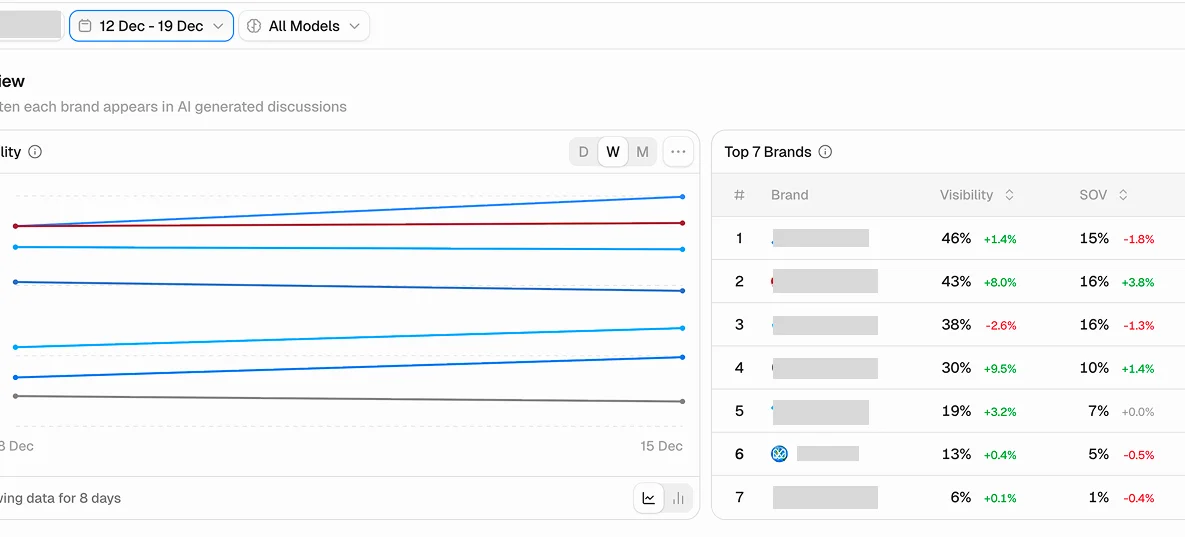
Peec.ai baseline - December 2025, before audit implementation
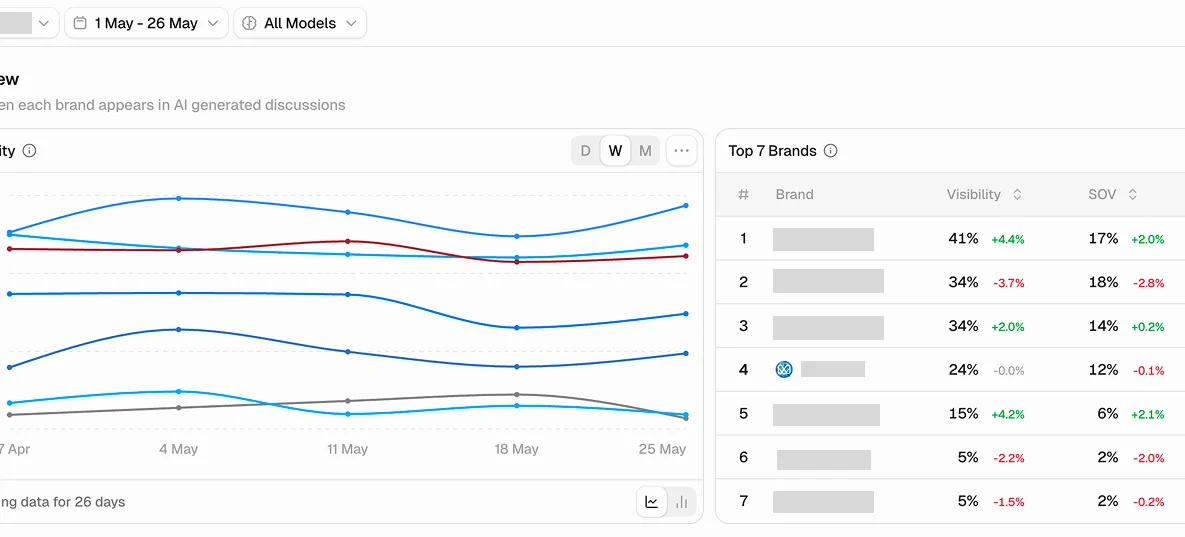
Peec.ai results - May 2026, after audit implementation
Results measured via Peec.ai - an AI search visibility monitoring platform tracking brand mentions across ChatGPT, Perplexity AI, Google AI Overviews, and Claude. Baseline: December 2025. Results: last 30 days as of May 2026. The brand name is withheld at the client's request; competitor names are unchanged from dashboard data.
Web Audits delivered a professional and well-structured AI visibility audit with a clear action plan. Every issue was documented and prioritised, and Nikola communicated consistently throughout.
Key Findings from the Audit
The main issues found and documented across AI visibility, content structure, authority signals, entity presence, and technical access.
When we tested 10 representative queries - "best travel route video maker", "how to create animated map video", "travel video tool for bloggers" - the product did not appear in a single response across ChatGPT, Perplexity, Claude, or Google AI Overviews. The top competitor appeared in 8 out of 10. This gap was the starting point for the entire audit - every finding traces back to the reasons behind it.
AI models don't only read your website - they cite what other sources say about you. At the time of the audit, the product had no meaningful presence on Reddit, no reviews on G2 or Product Hunt, no mentions in travel or creator community forums, and no press coverage. Competitors were regularly discussed in threads on r/travel, r/videography, and r/solotravel. As part of the implementation work, we placed relevant, non-promotional mentions of the product in active Reddit threads where users were asking about travel video tools - giving AI models real third-party sources to reference.
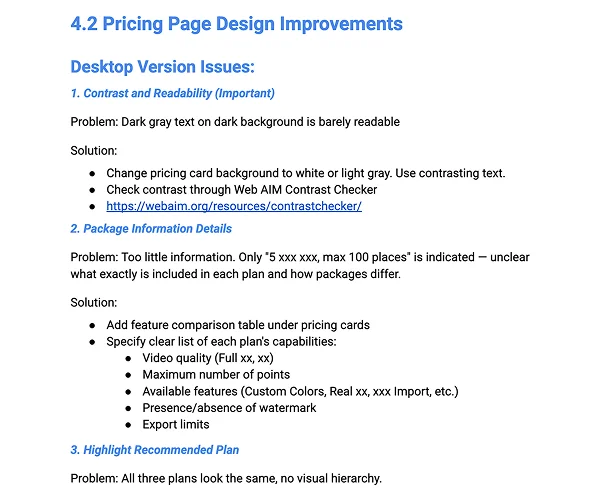
The pricing page required login to access, blocking all AI crawlers from indexing pricing data. When users ask AI models how much a travel video tool costs, the response pulls from indexed pricing pages - without it, the product is either skipped or described without pricing details, giving competitors a direct advantage in comparison queries. Opening the pricing page and adding Offer Schema with explicit plan details was one of the highest-impact fixes in the audit.
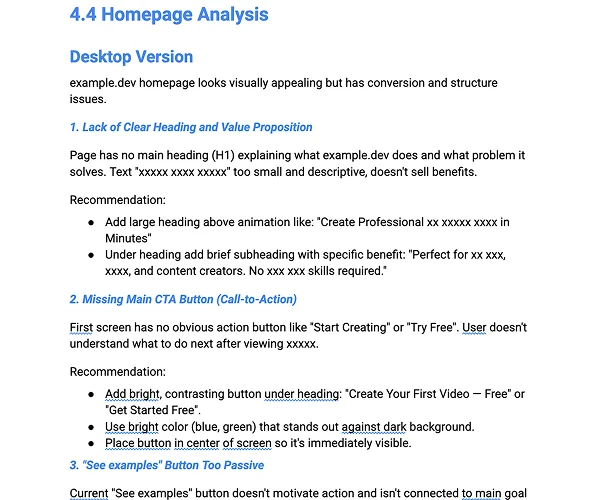
The homepage H1 and all subheadings described benefits and features without ever naming what the product actually is. Words like "travel route video creator" or "animated map tool" appeared nowhere in the heading structure. LLMs extract product definitions from headings first - without a category name, they either skip the product or misclassify it. This is the kind of fix that takes 10 minutes to implement and has an outsized effect on how AI models describe the product in generated answers.
The product had no Wikidata entry. Wikidata is one of the primary sources LLMs use to verify that a product exists and to establish basic facts about it - category, founding date, official URL, social profiles. All three top competitors had verified Wikidata items. Creating an entry and linking it via sameAs in the Organization Schema is free, takes a few hours, and directly increases the likelihood of the product appearing in AI-generated recommendations and comparisons.
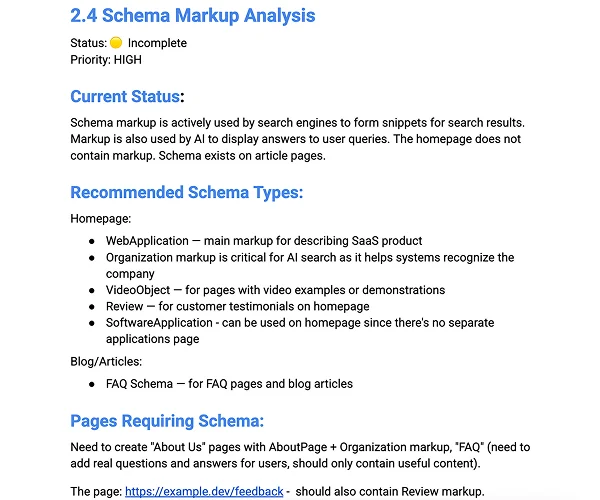
The homepage had no Organization Schema markup. Without it, AI models have no structured signal connecting the brand name to its product category, website, or social presence. All top competitors had comprehensive Organization Schema with sameAs links to Wikidata and social profiles. This is the on-site counterpart to the Wikidata entry - together they form the minimum viable entity footprint that AI models require before including a product in citations.
No FAQPage schema was present on any page. FAQ structured data is directly consumed by Perplexity, Google AI Overviews, and ChatGPT when generating answers to product questions. The audit identified specific high-intent questions - how to create a travel route video, what map styles are available, whether HD export is supported, what plans are available - that competitors were already capturing through FAQ schema while the client was absent from those answers entirely.
Most pages on the site contained under 200 words. AI models prioritise pages with enough context to extract a coherent answer from - a features page with 180 words gives the model almost nothing to work with, while a competitor's equivalent page at 900 words gets cited repeatedly. The audit flagged the homepage, features page, and use case sections as critically thin. Expanding each to a minimum of 600-800 words with structured content - what the tool does, who it's for, how it compares - was one of the most direct ways to increase the likelihood of appearing in AI-generated answers.
From the Audit Report
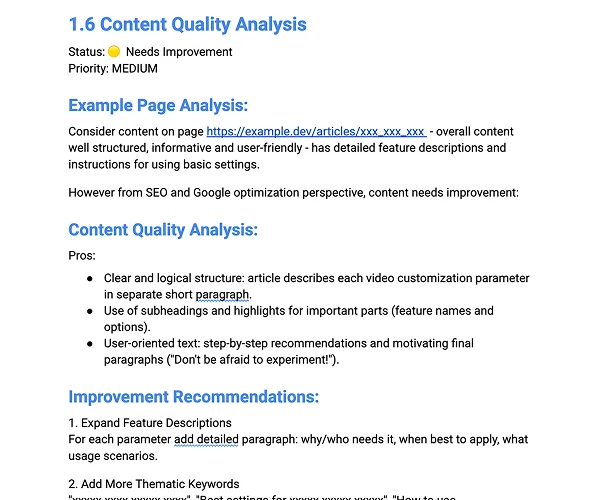
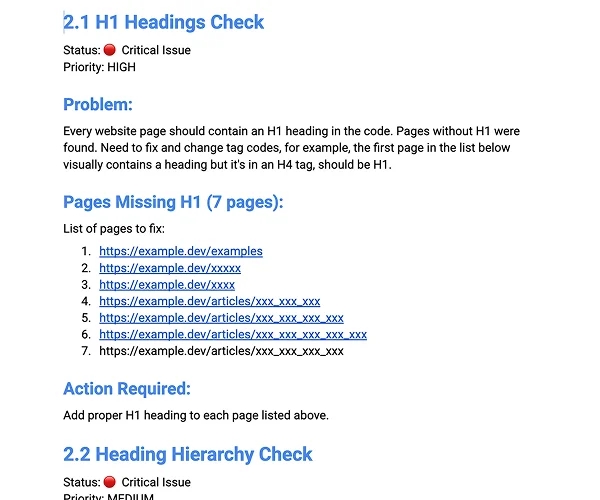
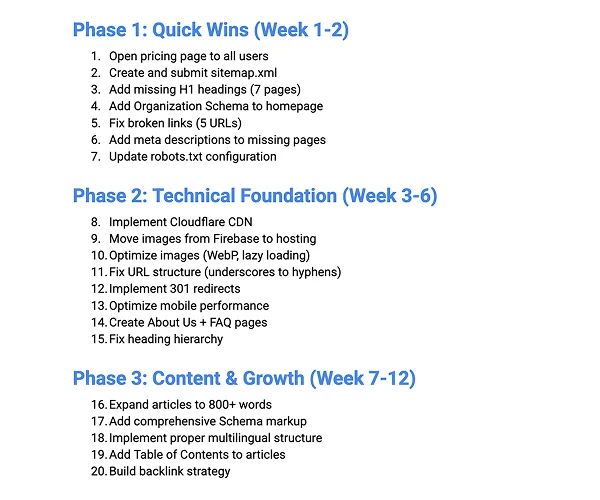
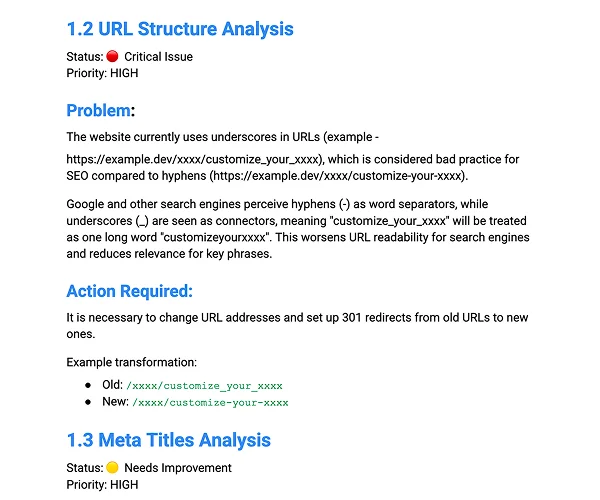
Real screenshots from the audit delivered to the client - issues identified, documented, and ranked by priority.
Services Used in This Project

AI Visibility Audit
Assessment of how AI search engines - Google AI Overview, ChatGPT, Perplexity, Claude - perceive, describe, and recommend your product. Covers content clarity, structured data, authority signals, and E-E-A-T.

SEO Audit
On-page analysis covering meta tags, heading structure, keyword usage, content uniqueness, internal linking, and schema markup opportunities.

Website Audit
Full-site review covering UX, conversion flow, content structure, and technical health - with prioritised fixes and implementation support.
Get a FREE Expert Review of Your Website
Manual review by a real SEO expert. No AI. Delivered within 24 hours.
- Manual review
- Personalized findings
- 24h delivery